CVE-2026-48172 puts LiteSpeed cPanel deployments on a KEV deadline

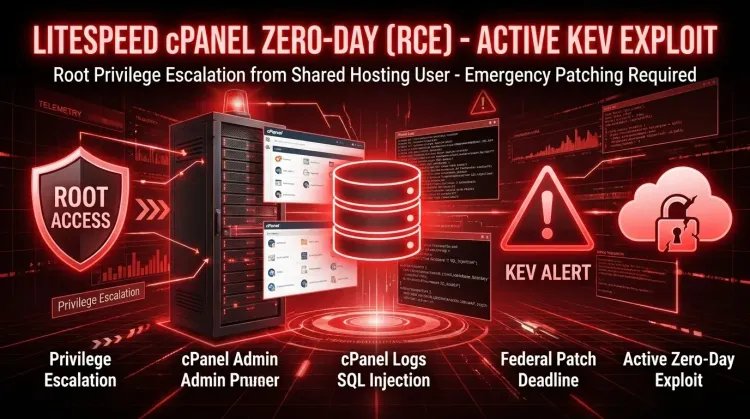
CVE-2026-48172 puts LiteSpeed cPanel deployments on a KEV deadline
CVE-2026-48172 has escalated from vendor emergency to federal patching priority. On May 26, 2026, CISA added the flaw to its Known Exploited Vulnerabilities catalog, and SecurityWeek reported the agency's remediation deadline for federal agencies is May 29, 2026. That is a short response window for a bug in a hosting control-plane component that can lead to root-level script execution.
The vulnerability affects the LiteSpeed user-end plugin for cPanel, not the parent WHM plugin itself. According to LiteSpeed, the issue was exploited in the wild as a zero-day and affects user-end plugin versions 2.3 through 2.4.4. In shared-hosting environments, that matters because a compromise in the panel layer can quickly expand the attack surface from one account to a full server incident.
Why this bug matters beyond patch management
LiteSpeed describes CVE-2026-48172 as a privilege escalation flaw tied to the lsws.redisAble function. Its advisory says any cPanel user, including an attacker using a compromised account, may be able to exploit the issue to execute arbitrary scripts as root.
That changes the risk profile immediately. This is not just a nuisance bug in a performance plugin. It sits inside a control-plane path used by hosting providers and administrators to expose management features to tenants. When an internet-facing or semi-trusted plugin can turn a low-trust position into root execution, defenders should treat it as a likely incident-response event, not just a routine maintenance update.
What changed after the first fix
One detail operators should not miss is that LiteSpeed's remediation story evolved over several days.
- The vendor says the original issue was patched in cPanel plugin v2.4.5.
- On May 19, 2026, LiteSpeed released cPanel plugin v2.4.6 and WHM plugin v5.3.0.0.
- On May 21, 2026, after an additional security review, LiteSpeed released cPanel plugin v2.4.7 bundled with WHM plugin v5.3.1.0.
The important operational takeaway is that LiteSpeed is not telling customers to stop at 2.4.5. Its current urgent recommendation is to upgrade to WHM Plugin v5.3.1.0 bundled with cPanel plugin v2.4.7 or higher. The reason is straightforward: the vendor found and hardened additional potential attack vectors during a broader review, even though it said those extra issues had not been observed under exploitation.
Affected versions and recommended action
Based on LiteSpeed's advisory and release notes:
- Affected: LiteSpeed user-end cPanel plugin v2.3 through v2.4.4
- Initial fix: v2.4.5
- Current recommended minimum: WHM Plugin v5.3.1.0 bundled with cPanel plugin v2.4.7
- If patching is not possible: uninstall the user-end cPanel plugin
LiteSpeed explicitly provides an uninstall fallback:
/usr/local/lsws/admin/misc/lscmctl cpanelplugin --uninstall
That fallback matters for teams that cannot safely update immediately, especially where customer-facing cPanel environments are exposed and change windows are constrained.
How to check whether a server may have been hit
LiteSpeed also published a simple server-side check for likely exploitation artifacts:
grep -rE "cpanel_jsonapi_func=redisAble" /var/cpanel/logs /usr/local/cpanel/logs/ 2>/dev/null
If this returns no output, the vendor says the server has not been affected by this exploit path. If it does return output, LiteSpeed recommends reviewing the listed IP addresses, blocking suspicious sources, and examining system logs for follow-on activity from those IPs.
That detection step should be treated as a triage aid, not a full compromise assessment. A positive hit means defenders should move past patching and into scoping, containment, credential review, and forensic validation. In multi-tenant hosting, the downstream blast radius can include websites, application data, and administrative actions performed after root access was obtained.
Why KEV status changes the urgency
There are plenty of high-severity plugin flaws every year. The reason this one stands out is the combination of factors:
- confirmed exploitation in the wild
- a path to root-level script execution
- location in a hosting control-plane component
- short remediation expectations after KEV inclusion
Once a vulnerability reaches KEV, the defender question is no longer whether the bug is theoretically dangerous. The question becomes whether exposed environments have already been probed or abused, and whether the organization can prove otherwise.
Immediate defensive priorities
1. Upgrade to the current recommended release, not just the first patched build
Move to WHM Plugin v5.3.1.0 with cPanel plugin v2.4.7 or later. Do not anchor on v2.4.5 simply because it fixed the original report.
2. Remove the user-end plugin if you cannot patch quickly
If change control or compatibility constraints delay remediation, uninstalling the vulnerable user-end plugin is the safer short-term choice than leaving it exposed.
3. Hunt for exploitation evidence
Run LiteSpeed's detection command, review cPanel and system logs, and correlate any suspicious IPs with account changes, script execution, or unexpected administrative actions.
4. Treat compromised or suspicious servers as high-impact cases
If evidence suggests abuse, begin formal digital forensics and response procedures. Root-level execution on a shared hosting server can invalidate trust in application content, stored credentials, scheduled jobs, and tenant boundaries.
Strategic takeaway
CVE-2026-48172 is a reminder that seemingly secondary management plugins can become primary compromise paths when they sit close to trust boundaries. For hosting providers and anyone running LiteSpeed with cPanel, this is a live control-plane risk with a very short response horizon.
The right response is to patch to the currently recommended version, reduce exposure if patching is delayed, and investigate vulnerable environments with the assumption that exploitation may already have been attempted.
References
FAQ
Written by
Lucas Oliveira
Research
A DevOps engineer and cybersecurity enthusiast with a passion for uncovering the latest in zero-day exploits, automation, and emerging tech. I write to share real-world insights from the trenches of IT and security, aiming to make complex topics more accessible and actionable. Whether I’m building tools, tracking threat actors, or experimenting with AI workflows, I’m always exploring new ways to stay one step ahead in today’s fast-moving digital landscape.
Hot TopicsLast 7 days
Categories
Stay Updated
Get the latest cybersecurity insights delivered to your inbox.