Microsoft March 2026 Patch Tuesday Fixes Two Publicly Disclosed Zero-Days and 79 Vulnerabilities

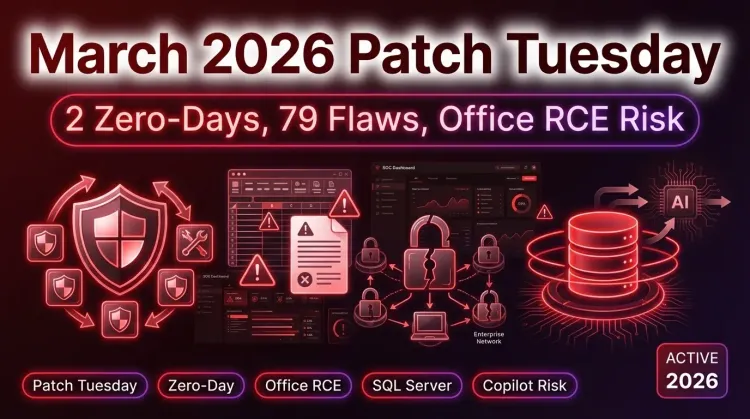
Microsoft March 2026 Patch Tuesday Fixes Two Publicly Disclosed Zero-Days and 79 Vulnerabilities
Microsoft’s March 2026 Patch Tuesday landed with a broad security payload: 79 vulnerabilities fixed, including two publicly disclosed zero-days and three critical flaws. While Microsoft said none of the zero-days were known to be actively exploited at the time of release, the update cycle still carries urgency for enterprise defenders because several issues affect high-value business workflows, including SQL Server privilege escalation, .NET denial of service, Office preview-pane remote code execution, and an Excel issue that could enable unintended data exfiltration through Copilot Agent mode.
For defenders, the headline is not just the number of patched flaws. It is the mix of bug classes and operational exposure. Patch Tuesday bundles regularly force organizations to decide what gets accelerated, what can wait, and what demands compensating controls before updates are fully deployed. In this release, Microsoft Office RCE paths, SQL Server privilege escalation, and cloud-adjacent issues should push patch teams to prioritize rapid validation and staged rollout.
Why this Patch Tuesday matters
According to BleepingComputer’s March 10 reporting, Microsoft addressed two publicly disclosed zero-day vulnerabilities as part of the March 2026 release. One is a SQL Server elevation-of-privilege flaw that can grant SQLAdmin privileges to an authorized attacker over the network. The other is a .NET denial-of-service issue caused by an out-of-bounds read.
On top of that, Microsoft fixed two Office remote code execution vulnerabilities — CVE-2026-26110 and CVE-2026-26113 — that can be triggered via the preview pane. That makes them especially important in enterprise environments where phishing and malicious attachment delivery remain standard intrusion paths.
Another issue likely to draw attention from security teams is CVE-2026-26144, a Microsoft Excel information disclosure flaw. Microsoft’s description indicates the bug could potentially allow Copilot Agent mode to exfiltrate data through unintended network egress, creating a zero-click information disclosure scenario. Even if exploitation remains theoretical or constrained, the combination of spreadsheet workflows, AI-assisted tooling, and enterprise data movement makes this class of issue strategically important.
Priority areas for defenders
1. Office preview-pane RCE exposure
Preview-pane exploitation lowers the bar for impact because a user may not need to fully open a malicious file for the attack chain to start. Organizations should treat Office-related fixes as a fast-track priority, especially for users in finance, HR, legal, and executive support roles who routinely receive attachments from external parties.
2. SQL Server privilege escalation
The SQL Server zero-day stands out because privilege escalation in database environments can become a bridge to broader compromise. If an attacker already has limited authorized access, elevating to SQLAdmin can expose sensitive records, enable lateral movement, and support persistence inside core business applications.
3. Excel and Copilot data egress risk
The Excel disclosure issue tied to Copilot Agent mode is a reminder that AI-assisted workflows now sit inside the attack surface, not outside it. Security teams should review where Copilot-style features are enabled, what outbound network controls exist, and whether sensitive spreadsheet processes are protected with stronger segmentation and monitoring.
Recommended response steps
Security and IT teams should focus on four practical actions:
- Prioritize patch validation for Office, SQL Server, and Excel endpoints first. Those areas combine business criticality with realistic attacker interest.
- Review email and attachment handling controls. Preview-pane RCE issues increase the value of attachment sandboxing, content disarm, and aggressive phishing filtering.
- Audit privileged SQL paths. Identify where lower-privileged accounts could become stepping stones to administrative access.
- Check AI workflow boundaries. If Copilot or similar agent features can move data across trust zones, validate egress policies and telemetry now rather than after an incident.
Organizations with slower patch windows should also consider temporary mitigations while change approvals move forward. In practice, that may include tightening attachment controls, restricting macro-capable workflows, monitoring SQL privilege changes, and reviewing outbound connections from systems handling sensitive office documents.
Strategic takeaway
March 2026 Patch Tuesday reflects a broader pattern in enterprise security: traditional vulnerabilities are now intersecting with productivity AI, cloud-connected administration paths, and deeply embedded business tooling. That means remediation is no longer just about installing updates. It is about understanding how a single flaw might influence identity, data flow, endpoint trust, and human workflows at once.
The most mature defenders will treat this month’s release as both a patching event and a risk review. The technical fixes are essential, but the bigger lesson is architectural: as AI-enabled enterprise tooling grows, vulnerability management must expand beyond CVSS triage into workflow-aware exposure analysis.
Sources
- BleepingComputer, "Microsoft March 2026 Patch Tuesday fixes 2 zero-days, 79 flaws," published March 10, 2026.
- Microsoft MSRC advisory references cited in the BleepingComputer Patch Tuesday roundup.
Written by
Lucas Oliveira
Research
A DevOps engineer and cybersecurity enthusiast with a passion for uncovering the latest in zero-day exploits, automation, and emerging tech. I write to share real-world insights from the trenches of IT and security, aiming to make complex topics more accessible and actionable. Whether I’m building tools, tracking threat actors, or experimenting with AI workflows, I’m always exploring new ways to stay one step ahead in today’s fast-moving digital landscape.
Hot TopicsLast 7 days
Categories
Stay Updated
Get the latest cybersecurity insights delivered to your inbox.