UK Launches Online Crime Centre to Disrupt Fraud | 2026

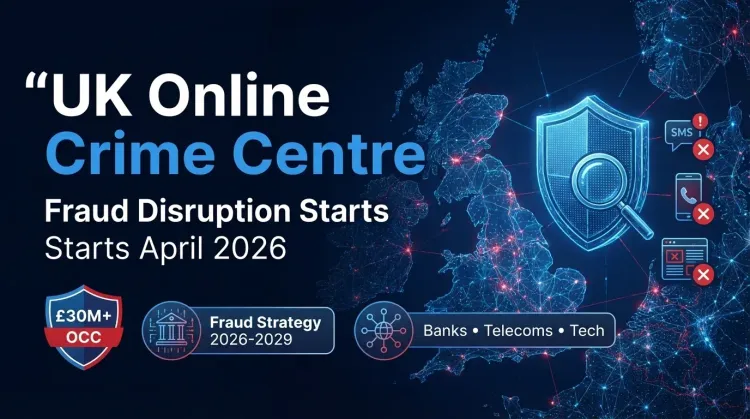
UK Launches Online Crime Centre to Disrupt Fraud | 2026
Executive Summary
The UK government has confirmed that a new Online Crime Centre (OCC) will begin operations in April 2026 as part of its Fraud Strategy 2026 to 2029, with more than £30 million allocated to the unit and £250 million committed across the wider anti-fraud plan over three years. According to Home Office material, the OCC will bring together government, police, intelligence agencies, banks, telecom providers and major technology firms to identify and disrupt the accounts, websites and phone numbers used by organized fraud networks.
For defenders, the story is not just a policy announcement. It signals a more operational model for tackling phishing, scam infrastructure, mule accounts and cross-platform abuse at scale. What remains unproven is whether the UK can turn voluntary cross-sector coordination into real-time disruption fast enough to materially reduce fraud losses.
What happened?
The government’s new strategy frames fraud as the UK’s most common crime and says a large share of it is cyber-enabled. The most concrete new measure is the launch of the Online Crime Centre, described in official government language as a disruption hub for fraud and high-volume cybercrime.
Confirmed timeline
- 2026-03-09 to 2026-03-10: The UK government publishes the Fraud Strategy 2026 to 2029 and associated announcement material.
- April 2026: The Online Crime Centre is scheduled to begin operations.
- By early 2028: The strategy says the UK also aims to introduce a national system to trace scam calls across telecom networks.
- 2027: The government expects to introduce a Fraud Victims Charter as part of the broader response pillar.
What is confirmed
From official UK government sources:
- the OCC is backed by over £30 million in funding
- it will combine public-sector and private-sector data and expertise
- participants include policing, intelligence agencies, banks, telecom operators and tech firms
- the mission is to identify and shut down fraud infrastructure at scale
- target actions include blocking scam texts, freezing accounts and removing fraudulent online profiles
- the broader strategy includes £250 million of investment over three years
What is still unclear
Several implementation details are still thin or absent in public material:
- whether participation by platforms is mandatory or largely voluntary
- what legal basis will govern near-real-time data sharing across sectors
- what success metrics will define “disruption” and by when
- how much of the model will focus on domestic enforcement versus overseas diplomatic and intelligence cooperation
Why this matters
This is a notable shift away from treating fraud purely as a downstream reimbursement or consumer-protection issue. The strategy explicitly tries to move “upstream,” focusing on the infrastructure and business processes that enable industrialized online scams.
That matters because large fraud ecosystems depend on a chain of enablers:
- fake or hijacked accounts
- spoofed or rotating phone numbers
- malicious domains and websites
- social media personas
- payment rails and mule accounts
- cross-border infrastructure that changes faster than traditional investigations move
In practical terms, the OCC is an attempt to turn dispersed threat intelligence and fraud telemetry into a shared operational picture, then use that picture to trigger faster intervention.
Who is affected?
The direct targets are organized fraud networks and other actors involved in online-enabled financial crime. Indirectly, the strategy affects several groups:
Financial institutions
Banks have long argued that many scams begin outside the banking perimeter, especially on telecom and social platforms. The OCC appears designed to support that argument by pulling more upstream actors into the disruption chain.
Telecom providers
Operators will face greater pressure to block or trace scam traffic, especially SMS and voice infrastructure used in vishing and impersonation campaigns.
Technology platforms
The strategy points to platform responsibility under existing laws such as the Online Safety Act, especially around fraudulent advertising and scam content.
Law enforcement and intelligence teams
The OCC is meant to reduce fragmentation between agencies and improve operational coordination on what the government calls “high harm” offenders.
UK businesses and consumers
The government says 1 in 14 adults and 1 in 4 businesses have been victims of fraud, while the annual economic cost exceeds £14 billion. Even if those numbers come from policy messaging rather than incident telemetry, they explain why the UK is treating fraud as both an economic and national security problem.
Operational model: what the OCC is supposed to do
Public statements from the Home Office and ministerial speech point to five core functions.
1) Fuse cross-sector data
The centre is supposed to bring together signals from banks, telecom firms, technology companies, police and intelligence partners into one shared view of criminal infrastructure.
2) Spot enablers and trends in real time
The minister’s launch speech explicitly says the OCC will “fuse data” and “spot enablers and trends in real time,” suggesting a stronger analytical focus on patterns rather than only case-by-case referrals.
3) Coordinate disruption
The intended disruption set includes:
- blocking scam texts
- freezing suspicious or criminal-linked accounts
- removing scam social media profiles
- taking down websites tied to fraud operations
4) Support international action
The government says more than two-thirds of fraud affecting the UK originates overseas, and cites agreements with countries including Nigeria and Vietnam. That means the OCC is being presented as both a domestic coordination node and an input to international action.
5) Feed the wider fraud response
The strategy also ties the OCC to the newer Report Fraud platform operated by the City of London Police, which is meant to replace the widely criticized Action Fraud model with better data quality and faster analysis.
Detection and exposure guidance for defenders
Even if the OCC is a government initiative rather than a specific vulnerability, defenders can still take useful cues from the threat model behind it.
Watch for these patterns
- spikes in inbound social engineering attempts over SMS, voice and social media
- repeated impersonation themes tied to banks, HMRC, delivery brands or government services
- clusters of newly registered domains matching payment, refund or identity-verification themes
- mule-account behavior and fast cash-out after customer-contact events
- cross-channel scam journeys where email, SMS, voice and web infrastructure are used together
Example Splunk hunting pattern
index=email OR index=web OR index=proxy OR index=sms
("verify your account" OR "payment suspended" OR "refund due" OR "security alert")
| stats count values(src) values(dest) values(domain) values(user) by _time, channel, sender
| sort - count
Example hunting pattern only. Tune terms, fields and channels to local telemetry.
Example KQL pattern
union isfuzzy=true EmailEvents, UrlClickEvents, DeviceNetworkEvents
| where Timestamp > ago(7d)
| where tostring(SenderFromAddress) has_any ("bank", "gov", "delivery")
   or tostring(Url) has_any ("verify", "refund", "secure-message")
| summarize Count=count(), Urls=make_set(Url, 20), Senders=make_set(SenderFromAddress, 20) by bin(Timestamp, 1h)
| order by Count desc
Example pattern only. Adjust table names and fields to your environment.
Containment and remediation checklist
🔴 Immediate actions (0-24h)
- review current scam and fraud reporting flows across security, fraud and customer-support teams
- identify where fraud telemetry is siloed between email, telecom, banking and platform teams
- block known scam domains, URLs and phone-number patterns faster across all available channels
- prioritize cases involving impersonation of financial, government or identity services
- escalate high-volume campaigns that show cross-channel coordination
🟠 Hardening (24-72h)
- create a shared fraud-disruption playbook across SOC, fraud, abuse and legal teams
- reduce time-to-takedown for malicious domains, profiles and messages
- enrich detections with telecom, identity and payment telemetry where available
- improve case linking so that related email, SMS, voice and web artifacts are grouped together
- validate reimbursement, customer-notification and recovery workflows for scam victims
🟡 Longer-term controls (1-4 weeks)
- invest in cross-channel fraud correlation rather than channel-specific detections only
- formalize partnerships with telecom, banking and platform peers for abuse escalation
- measure disruption outcomes, not just alert counts
- use tabletop exercises that simulate industrialized scam operations rather than single-event fraud
- align fraud and cyber incident response so that large-scale scam activity is treated as a security problem, not only a compliance issue
Strategic analysis
The UK announcement is important because it acknowledges a reality defenders already know: many of today’s scams are not isolated consumer complaints but industrialized cyber-enabled operations run across jurisdictions and platforms.
Three strategic signals stand out.
Fraud is being reframed as a national-security and economic-security issue
That reframing matters because it can justify more intelligence support, more international coordination and faster disruption authorities.
The pressure is shifting upstream
Banks have argued for years that they should not be the only sector expected to absorb fraud losses when scam origination often starts elsewhere. The OCC appears designed to translate that pressure into an operating model spanning telecoms and technology providers.
Execution will determine credibility
The government messaging is strong, but the real test will be whether the OCC can turn shared data into action quickly enough to disrupt adaptive criminal networks. If intelligence sharing remains slow, manual or legally ambiguous, the centre risks becoming another coordination layer rather than a true disruption engine.
References
- Fraud Strategy 2026 to 2029
- New disruption unit launched in crackdown on fraud
- Fraud Strategy launch speech
- UK plans to shift fraud fight onto telecoms, tech companies
Published: 2026-03-11 Author: Invaders Cybersecurity Classification: Public / TLP:CLEAR Reading Time: 8 minutes
FAQ
Written by
Lucas Oliveira
Research
A DevOps engineer and cybersecurity enthusiast with a passion for uncovering the latest in zero-day exploits, automation, and emerging tech. I write to share real-world insights from the trenches of IT and security, aiming to make complex topics more accessible and actionable. Whether I’m building tools, tracking threat actors, or experimenting with AI workflows, I’m always exploring new ways to stay one step ahead in today’s fast-moving digital landscape.
Hot TopicsLast 7 days
Categories
Stay Updated
Get the latest cybersecurity insights delivered to your inbox.