Joomla JCE exploitation forces defenders beyond simple patching

Joomla JCE exploitation forces defenders beyond simple patching
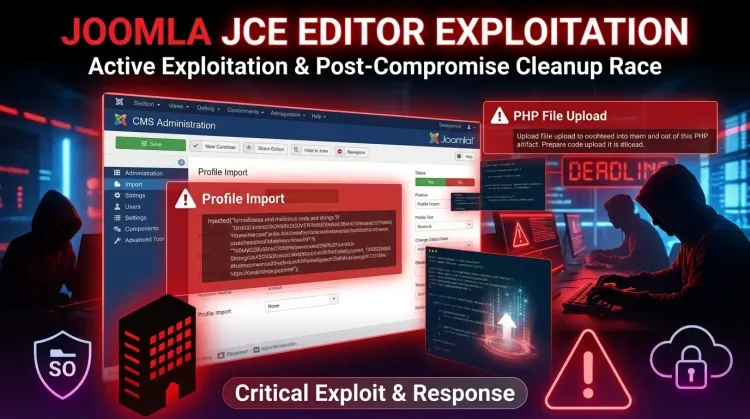
On Friday, June 19, 2026, defenders running Joomla sites with the JCE editor are at a deadline, not a discovery stage. CVE-2026-48907 is an actively exploited vulnerability in the Joomla Content Editor that lets unauthenticated attackers create editor profiles and turn that access into PHP file upload and execution. CISA added the flaw to its Known Exploited Vulnerabilities catalog on June 16, 2026 with a due date of June 19, 2026 for federal remediation. The vendor says exploit code is public, attacks are automated, and patching alone does not clean a site that was already compromised. For defenders, this is now an incident response and exposure-validation problem, not just a patch-management task.
What is confirmed
Several facts are solid enough to act on immediately.
- The JCE vendor released version 2.9.99.5 on June 3, 2026 to fix a critical issue affecting all earlier JCE Pro versions.
- On June 12, 2026, the vendor said the flaw was being actively exploited, that working exploit code was public, and that attacks were automated.
- The same June 12 guidance said the attack path involves importing a rogue editor profile that permits executable uploads, then using that profile to upload a payload.
- NVD describes the impact as unauthenticated creation of editor profiles leading to PHP upload and code execution, with a CNA CVSS v4 score of 10.0 and an NVD CVSS v3.1 score of 9.8.
- CISA added CVE-2026-48907 to the KEV catalog on June 16, 2026 and set June 19, 2026 as the remediation due date for federal agencies.
- On June 18, 2026, the vendor released JCE 2.9.99.7 with further hardening and fixes for upload issues some sites experienced after 2.9.99.6.
That last point matters. Some teams delay urgent updates after seeing operational regressions in follow-on builds. The June 18 release is the clearest signal yet that defenders now have both the security fix and additional hardening in a more stable package.
Why patching is necessary but not sufficient
The most important operational detail in the vendor guidance is that updating closes the entry point but does not remove attacker artifacts already left behind. That is the difference between a routine access control issue and a post-compromise response scenario.
According to the vendor, the reliable sign of exploitation is not a dashboard warning but server evidence. Teams should review web server access logs for unauthenticated requests to the JCE profile import task, especially index.php?option=com_jce&task=profiles.import. They should also inspect JCE Editor Profiles for unfamiliar entries, especially meaningless or auto-generated names placed near the top of the list, and check whether those profiles permit PHP or other script uploads.
The guidance also notes that some affected sites may show a degraded front-end editor toolbar. That is only a hint, not proof. The stronger story emerges when toolbar anomalies, unfamiliar profiles, and suspicious uploads appear together.
Versions and remediation paths
The remediation path now depends on how modern the Joomla environment is.
Supported path
If the site can run PHP 7.4 and Joomla 3.10 or later, the cleanest route is to update to JCE 2.9.99.7. The vendor states that the underlying flaw was fixed in 2.9.99.5, 2.9.99.6 added hardening, and 2.9.99.7 continues that work while fixing upload problems some sites saw in the previous release.
Legacy path
If the environment cannot yet move to 2.9.99.6 or later, the vendor published a free patch package on June 12, 2026 for JCE 2.7.x through 2.9.x. That package is explicitly a stopgap. It closes the vulnerability but does not include the extra hardening from 2.9.99.6 or clean a compromised site.
Operational hardening
JCE 2.9.99.7 adds a new "Permitted User Groups" option that lets administrators whitelist which groups are eligible for profile assignment and import. That is a meaningful defense-in-depth control because it narrows misuse of over-permissive group mappings even after the core fix is applied.
What defenders should do today
Immediate containment and validation
- Update JCE to 2.9.99.7 where the platform supports it, or apply the vendor patch package if an immediate upgrade path is blocked.
- Review JCE Editor Profiles for entries you did not create and delete only the rogue profiles after preserving evidence.
- Search for unexpected PHP or script files uploaded through JCE-managed paths.
- Pull web server access logs and look for unauthenticated calls to the profile import task to establish first-seen timing.
- Assume credentials tied to Joomla administration, hosting, FTP, and databases may require rotation if compromise is plausible.
Short-term hardening
- Restrict who can assign or import JCE profiles and configure the new permitted-group whitelist where available.
- Reduce public exposure of administrative paths and review whether guest-accessible flows are broader than intended.
- Confirm backups predate the earliest suspicious profile-import activity before using them for recovery.
- Hunt for follow-on persistence such as scheduled tasks, modified templates, or unexpected web-accessible scripts.
Strategic takeaway
This is a strong example of why active exploitation stories should be framed as threat intelligence plus cleanup, not patching alone. A CMS extension flaw becomes materially worse once attackers can automate profile abuse, upload executable content, and leave behind persistence before defenders notice the initial entry.
The practical lesson is simple: if a JCE site was unpatched between June 3 and June 19, 2026, there is a meaningful difference between "now fixed" and "now trustworthy." Mature handling requires both remediation and compromise assessment.
References
FAQ
Written by
Lucas Oliveira
Research
A DevOps engineer and cybersecurity enthusiast with a passion for uncovering the latest in zero-day exploits, automation, and emerging tech. I write to share real-world insights from the trenches of IT and security, aiming to make complex topics more accessible and actionable. Whether I’m building tools, tracking threat actors, or experimenting with AI workflows, I’m always exploring new ways to stay one step ahead in today’s fast-moving digital landscape.
Hot TopicsLast 7 days
Categories
Stay Updated
Get the latest cybersecurity insights delivered to your inbox.