CVE-2026-42897 makes on-prem Exchange an immediate mitigation priority

CVE-2026-42897 makes on-prem Exchange an immediate mitigation priority
CVE-2026-42897 is the kind of zero-day defenders hate: active exploitation is already confirmed, a permanent patch is not yet available, and the exposed surface sits inside on-prem Microsoft Exchange deployments that many organizations still treat as business-critical infrastructure.
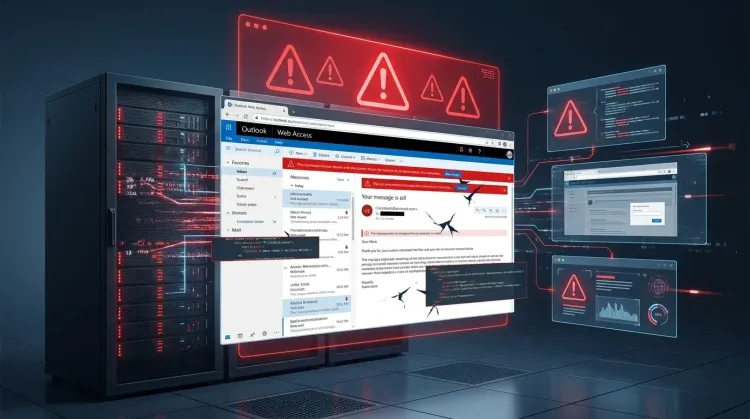
Microsoft says the flaw affects Outlook Web Access in Exchange Server 2016, 2019, and Subscription Edition. The vulnerability is described as a spoofing issue rooted in cross-site scripting, meaning a crafted email can trigger attacker-controlled JavaScript in the victim's browser when opened in OWA under the right conditions. That turns inbox access into a realistic exploit path rather than a theoretical bug.
Why this story matters now
This is not a routine Patch Tuesday problem. Microsoft disclosed exploitation before releasing a full fix and is steering customers toward the Exchange Emergency Mitigation Service (EEMS) and the Exchange On-premises Mitigation Tool for immediate containment.
That changes the defender workflow in three important ways:
- Exposure review becomes urgent. Teams need to identify every internet-facing or weakly segmented OWA instance right away.
- Mitigation must happen before patching. If EEMS is disabled or unsupported, admins need a manual fallback instead of waiting for a cumulative update.
- Potential compromise review cannot be skipped. Once exploitation is confirmed in the wild, mitigation only closes the door forward. It does not prove the environment was untouched before remediation.
For security leaders, this is an incident response story as much as a vulnerability management story.
What Microsoft has confirmed
According to Microsoft's advisory and downstream reporting, an attacker can send a specially crafted email to a target user. If that email is opened in OWA and certain interaction conditions are met, arbitrary JavaScript may execute in the browser context.
Public reporting has not yet clarified the scale of exploitation, the threat actor behind it, or the exact follow-on objectives in observed attacks. But the known facts are already enough to justify accelerated handling:
- exploitation is detected,
- on-prem Exchange is affected,
- Exchange Online is not affected,
- and Microsoft is relying on temporary mitigations while engineering a permanent fix.
That last point matters. Temporary controls are useful, but they also introduce operational risk when teams assume a mitigation equals full closure.
The real operational risk
At first glance, some teams may downplay this because it is "just XSS." That would be a mistake.
On OWA, browser-side script execution can still support credential theft, session abuse, malicious content rendering, spoofed user actions, or follow-on delivery of phishing content inside a trusted mail workflow. In practice, anything that lets an attacker hijack user trust inside a webmail session deserves priority—especially on infrastructure that often remains exposed for remote access.
The issue is also a reminder that legacy collaboration and messaging platforms remain attractive targets because they blend identity, sensitive communications, administrative access, and high business dependence in one place. From a threat intelligence perspective, Exchange still sits in the category of systems where attackers only need one workable weakness to create disproportionate downstream risk.
What defenders should do right now
1. Confirm whether EEMS is active
If Exchange Emergency Mitigation Service is enabled and the server version is recent enough to receive new mitigations, verify that the mitigation for CVE-2026-42897 is applied successfully.
2. Handle air-gapped or legacy cases explicitly
If EEMS cannot be used, Microsoft recommends applying the latest Exchange On-premises Mitigation Tool from an elevated Exchange Management Shell. Do not leave these environments in a "we'll patch later" state.
3. Review OWA exposure
Identify externally reachable OWA endpoints and restrict access where possible. If there is no clear inventory, treat that uncertainty as a security finding.
4. Expect side effects from mitigation
Microsoft notes that some mitigation paths can impact OWA calendar printing, inline image display, and OWA light behavior. That is inconvenient, but still preferable to leaving an actively exploited server exposed.
5. Investigate for suspicious user-session behavior
Because the exploit path is email-to-browser, defenders should review suspicious mail delivery, anomalous OWA activity, unexpected client-side behavior, and any signs of credential or session abuse around exposed Exchange infrastructure.
Timeline
| Date | Event | Status |
|---|---|---|
| May 15, 2026 | Microsoft disclosed CVE-2026-42897 with exploitation detected | 🔴 Active exploitation |
| May 15, 2026 | Microsoft advised EEMS or EOMT as immediate mitigation | 🛡️ Temporary mitigation |
| Pending | Permanent security update for affected on-prem Exchange versions | ⏳ Not yet available |
Strategic takeaway
CVE-2026-42897 deserves attention not because it is the most exotic Exchange flaw in recent memory, but because it hits a familiar weak point in enterprise security operations: business-critical, externally reachable infrastructure that cannot be taken down easily and is often slower to modernize.
If your organization still runs on-prem Exchange, the right default assumption is simple: treat this as an urgent mitigation and validation exercise, not a patch-you-get-to-next-week item.
References
FAQ
Written by
Lucas Oliveira
Research
A DevOps engineer and cybersecurity enthusiast with a passion for uncovering the latest in zero-day exploits, automation, and emerging tech. I write to share real-world insights from the trenches of IT and security, aiming to make complex topics more accessible and actionable. Whether I’m building tools, tracking threat actors, or experimenting with AI workflows, I’m always exploring new ways to stay one step ahead in today’s fast-moving digital landscape.
Hot TopicsLast 7 days
Categories
Stay Updated
Get the latest cybersecurity insights delivered to your inbox.