CISA's June 28 KEV deadline puts PTC Windchill and Cisco Unified CM on emergency footing

CISA's June 28 KEV deadline puts PTC Windchill and Cisco Unified CM on emergency footing
CISA's latest Known Exploited Vulnerabilities update has turned Sunday, June 28, 2026 into a hard operational deadline for two very different enterprise platforms: PTC Windchill/FlexPLM and Cisco Unified Communications Manager. The common thread is not product category. It is active exploitation, short remediation windows, and systems that often sit close to sensitive business operations.
The first issue, CVE-2026-12569, affects PTC Windchill PDMlink and PTC FlexPLM. It is a critical remote code execution flaw tied to improper input validation and deserialization of untrusted data. PTC and public reporting say attackers have been using the flaw to deploy persistent JSP web shells against vulnerable systems.
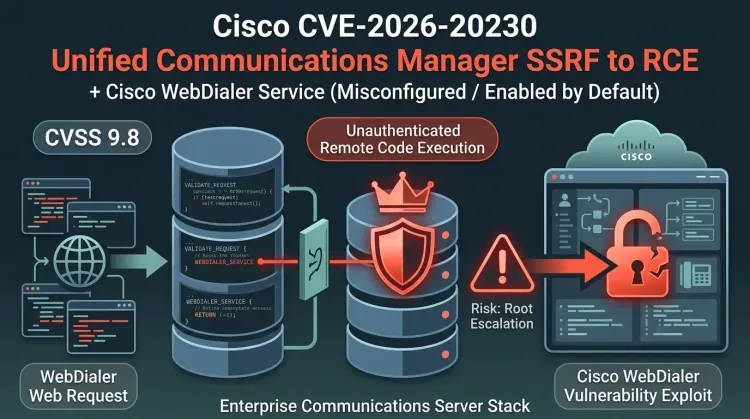
The second issue, CVE-2026-20230, affects Cisco Unified Communications Manager and Unified CM Session Management Edition when the WebDialer service is enabled. NVD describes it as a server-side request forgery issue that can let an unauthenticated attacker write files to the underlying operating system, creating a path to later root-level compromise.
For security teams, this is a classic vulnerability management moment where the checklist is not enough. If either system was exposed and unpatched during the exploitation window, the right question is not only "did we apply the update?" It is "did anyone get in before we applied it?"
What CISA changed
CISA added both CVEs to the KEV catalog on June 25, with a due date of June 28 under the agency's risk-based patching requirements. That three-day window matters because KEV entries are not theoretical vulnerability advisories. They represent weaknesses with evidence of real-world exploitation.
In practical terms, federal civilian agencies must apply vendor guidance or stop using affected products if mitigations are unavailable. Private-sector defenders are not legally bound by the same directive, but KEV additions remain a strong prioritization signal because they separate "important someday" from "being used now."
CVE-2026-12569: PTC Windchill and FlexPLM RCE
PTC Windchill and FlexPLM are product lifecycle management platforms used across manufacturing, engineering, retail, footwear, apparel, aerospace, defense, automotive, and heavy industry. They can hold engineering data, product definitions, supplier information, CAD-linked workflows, and other material that attackers would find valuable.
CVE-2026-12569 is reported as a critical remote code execution issue caused by deserialization of untrusted data. NVD lists a CVSS-B 9.3 critical score from PTC, and PTC's advisory is the main source for exact affected releases and fixes.
The exploitation detail is the real alarm bell. Public reporting says attackers are deploying JSP web shells under paths matching:
/Windchill/login/[0-9a-f]{16}.jsp
PTC also published indicators tied to the activity, including the command-and-control address 5.180.41.35, suspicious HTTP POST requests to /Windchill/login/*.jsp, and a file-listing artifact named flst.txt in /tmp or the Windchill working directory.
That moves this from routine patching into incident response. A web shell is not just an exploit attempt. It is a persistence mechanism. If defenders find one, they should assume the attacker intended continued access, command execution, data theft, and potentially lateral movement.
Why Windchill exposure is a supply chain risk
Windchill is not a generic content app. In many organizations, it sits near the product engineering backbone. A compromise can expose design files, manufacturing data, supplier context, lifecycle documentation, and operational process information.
That makes the risk broader than one application server. A successful attacker may be able to use PLM access to understand how products are built, what suppliers are involved, where sensitive intellectual property lives, and which downstream systems can be reached from the PLM environment.
This is why network segmentation matters. If an internet-facing Windchill login endpoint can reach file shares, engineering repositories, build systems, identity infrastructure, or manufacturing-adjacent systems without strong controls, exploitation can become a supply chain and operational resilience problem very quickly.
CVE-2026-20230: Cisco Unified CM SSRF with root-level consequences
The Cisco flaw is different, but it is also uncomfortable for defenders. CVE-2026-20230 is an unauthenticated server-side request forgery issue in Cisco Unified CM and Unified CM SME. Cisco rated the advisory as critical because exploitation can lead to root-level impact, even though the CVSS 3.1 score shown by NVD is 8.6 high.
NVD notes that the WebDialer service must be enabled, and that WebDialer is disabled by default. That helps, but it does not eliminate risk. Large enterprise communications platforms often carry years of configuration history, third-party integrations, and operational exceptions. The only reliable answer is asset-level verification.
For exposed systems, defenders should confirm:
- whether Unified CM or Unified CM SME is running affected 14.x or 15.x releases
- whether WebDialer is enabled
- whether vendor updates or interim fixes have been applied
- whether unusual file writes or post-exploitation behavior occurred
- whether internet exposure was present during the active exploitation window
Unified communications infrastructure is also attractive because it is business-critical. Downtime can disrupt voice, emergency communications, help desks, call centers, and internal coordination. Attackers know that pressure.
Defender response: patch and hunt in the same motion
For both CVEs, the response should combine remediation with evidence review.
1. Patch or mitigate immediately
Apply PTC and Cisco guidance first. For PTC, use the vendor advisory for exact Windchill and FlexPLM release coverage and mitigation steps. For Cisco, upgrade affected Unified CM and Unified CM SME deployments or apply vendor-provided interim fixes where relevant.
If a vulnerable product cannot be fixed immediately, remove internet exposure and place compensating controls in front of it while the permanent fix is scheduled. For a KEV issue with active exploitation, "monitoring only" is a weak position.
2. Hunt for PTC web shell activity
PTC environments should be checked for:
- JSP files matching
/Windchill/login/[0-9a-f]{16}.jsp - POST requests to
/Windchill/login/*.jsp - network traffic to
5.180.41.35 - suspicious files named
flst.txt - request headers containing
X-windchill-req: - unusual child processes spawned by the application server
- unexpected outbound connections from Windchill hosts
If any of these appear, treat the host as compromised. Preserve evidence, isolate carefully, rotate credentials, review authentication logs, and check adjacent systems reachable from the PLM tier.
3. Verify Cisco WebDialer exposure
For Cisco Unified CM, defenders should not rely on default assumptions. Confirm whether WebDialer is enabled, validate installed versions, and review for suspicious file creation or behavior consistent with SSRF abuse.
Even if the service is internal-only, review whether VPN, partner networks, support tunnels, or exposed management paths could give attackers a route to the vulnerable interface.
4. Rotate secrets where compromise is plausible
If exploitation indicators are present, credentials exposed to the affected servers should be considered suspect. That includes application service accounts, database credentials, API tokens, local admin credentials, SSH keys, and integration secrets.
For Windchill in particular, review access to engineering repositories, file stores, supplier portals, and identity integrations. A web shell on a PLM server can be a bridge into much more sensitive terrain.
5. Improve KEV-driven prioritization
The speed of this deadline is the point. Teams need a process that maps KEV entries to assets, owners, internet exposure, compensating controls, and incident-response requirements without waiting for manual triage.
The useful internal standard is simple:
KEV + exposed asset + active exploitation = emergency change and compromise assessment
That standard should trigger threat intelligence review, owner notification, patch validation, and post-remediation hunting.
Bottom line
CISA's June 28 deadline is not just another patch reminder. It is a signal that attackers are already moving against systems that many organizations use for product engineering and enterprise communications.
For PTC Windchill and FlexPLM, the priority is to patch, search for JSP web shells, block known attacker infrastructure, restrict exposed login paths, and treat any indicator as an incident. For Cisco Unified CM, the priority is to verify WebDialer exposure, apply fixes, and look for signs that attackers used SSRF to write files or stage privilege escalation.
The strongest teams will not split patching and hunting into separate workstreams. They will do both now, because active exploitation means the attacker may already be ahead of the maintenance window.
References
- CISA Adds Two Known Exploited Vulnerabilities to Catalog
- Known Exploited Vulnerabilities Catalog
- CVE-2026-12569 Detail
- CVE-2026-20230 Detail
- PTC Security Advisory CS473270
- Cisco Security Advisory: Cisco Unified Communications Manager Server-Side Request Forgery Vulnerability
- First-Ever Exploitation of PTC Windchill Vulnerability Discovered in the Wild
- CISA sets urgent deadline to fix Cisco flaw exploited in attacks
FAQ
Written by
Lucas Oliveira
Research
A DevOps engineer and cybersecurity enthusiast with a passion for uncovering the latest in zero-day exploits, automation, and emerging tech. I write to share real-world insights from the trenches of IT and security, aiming to make complex topics more accessible and actionable. Whether I’m building tools, tracking threat actors, or experimenting with AI workflows, I’m always exploring new ways to stay one step ahead in today’s fast-moving digital landscape.
Hot TopicsLast 7 days
Categories
Stay Updated
Get the latest cybersecurity insights delivered to your inbox.