Adobe ColdFusion CVE-2026-48282 moves from patch advisory to active exploitation

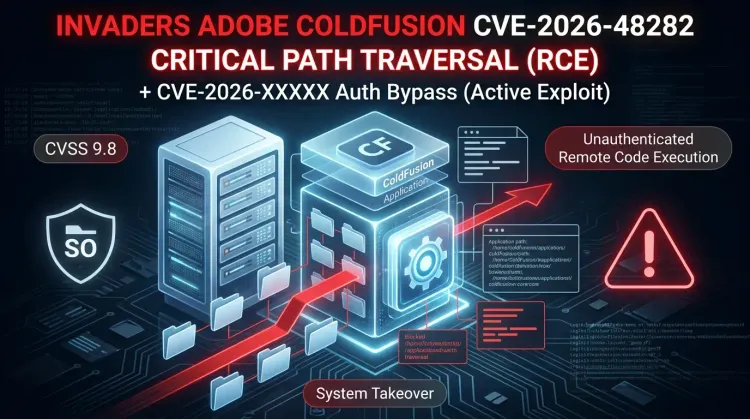
Adobe ColdFusion CVE-2026-48282 moves from patch advisory to active exploitation
Adobe ColdFusion administrators have a narrow patch window for CVE-2026-48282, a maximum-severity path traversal vulnerability now reported as exploited in attacks.
The bug affects ColdFusion 2025 Update 9 and earlier, and ColdFusion 2023 Update 20 and earlier. Adobe fixed it in ColdFusion 2025 Update 10 and ColdFusion 2023 Update 21 as part of security bulletin APSB26-68, which addressed a wider group of critical and important issues that could lead to arbitrary code execution, privilege escalation, arbitrary file-system read, and security-feature bypass.
The operational change is that this is no longer just a patch bulletin. BleepingComputer reported on July 7, 2026 that attackers are now exploiting CVE-2026-48282 against unpatched ColdFusion systems. The Hacker News also reported that exploitation attempts were observed within hours of public disclosure, including a request pattern aimed at reading C:\Windows\win.ini.
For defenders, that turns the priority from "schedule the Adobe update" into "patch, verify exposure, and inspect logs."
What the vulnerability does
NVD describes CVE-2026-48282 as an improper limitation of a pathname to a restricted directory. In practical terms, ColdFusion does not sufficiently constrain attacker-controlled file paths in an affected code path.
That matters because path traversal is rarely just a file-reading nuisance on application servers. On a platform like ColdFusion, where server-side components can process templates, files, and administrative functions, file-system access can become remote code execution when attackers can place or influence content that the server later executes.
Adobe's advisory gives CVE-2026-48282 a critical severity rating and lists it as exploitable without user interaction. NVD assigns it a CVSS 3.1 score of 10.0, reflecting network reachability, low attack complexity, no required privileges, and high impact.
Why ColdFusion exposure is high-value
ColdFusion commonly sits behind business workflows that are older, important, and difficult to move quickly. That combination is attractive to attackers.
An exposed ColdFusion server may front customer portals, administrative workflows, internal applications, reporting systems, partner integrations, or document-heavy enterprise processes. If the server is internet-facing and unpatched, exploitation can give attackers a foothold in a zone where application secrets, database connectivity, upload directories, and service-account permissions are often nearby.
The risk is not limited to the ColdFusion process. A successful exploit can become an initial access event, followed by web shell deployment, credential harvesting, lateral movement, or staging for ransomware. Even where the exploited process runs with constrained permissions, attackers may still obtain configuration files, database credentials, API keys, or session material that opens the next door.
What changed after the patch
Adobe published APSB26-68 on June 30, 2026. At publication time, Adobe said it was not aware of exploits in the wild for the issues addressed by the update. That is a normal and useful baseline, but it can age quickly once researchers, defenders, and attackers all begin diffing the patch.
Within days, security vendors and researchers were documenting the vulnerable surface and exploitation mechanics. WatchTowr analyzed the ColdFusion bulletin and emphasized how broad the affected version range was: ColdFusion 2025 Update 9 and below, and ColdFusion 2023 Update 20 and below. Qualys summarized multiple critical ColdFusion bugs from the same bulletin, including CVE-2026-48282 as a path traversal issue that may allow arbitrary code execution.
Then exploitation reports appeared. The important timeline for defenders is simple:
2026-06-30: Adobe publishes APSB26-68 and fixed ColdFusion updates.
2026-06-30: NVD receives CVE-2026-48282 from Adobe.
2026-07-01: Public analysis begins circulating around the ColdFusion fixes.
2026-07-06/07: Public reporting says CVE-2026-48282 exploitation is underway.
That is a short gap between patch release and active exploitation. It reinforces a familiar pattern: once a critical enterprise server bug is patched, the patch itself becomes a roadmap for attackers who expect slow update cycles.
Who needs to act now
The priority group is any organization running Adobe ColdFusion 2023 or 2025, especially internet-facing systems, hosted customer portals, partner-facing workflows, and administrative applications.
Security teams should not assume ColdFusion is absent just because it is no longer part of a new application stack. Many environments still keep ColdFusion systems alive for long-running business processes. The asset may be owned by a business unit, a legacy application team, a vendor, or a managed hosting provider rather than the central security team.
Managed service providers and hosting teams should treat this as a customer notification issue. If ColdFusion is exposed on behalf of customers, the patch status and logs need to be reviewed across tenants.
Immediate response checklist
Start with exposure and patch status:
- Inventory ColdFusion 2023 and 2025 servers, including externally hosted systems.
- Upgrade ColdFusion 2025 to Update 10 or later.
- Upgrade ColdFusion 2023 to Update 21 or later.
- Confirm the update was applied on every node, not just one member of a cluster.
- Remove public exposure from ColdFusion administration and development interfaces wherever possible.
Then inspect for exploitation:
- Review web server and ColdFusion logs for path traversal payloads, unusual file-access requests, and requests targeting ColdFusion administrative or development endpoints.
- Look for attempted reads of Windows test files such as
C:\Windows\win.ini, which has already appeared in public exploitation reporting. - Search for newly created
.cfm,.jsp,.war, or other executable files in web-accessible paths. - Review recent changes under
CFIDE, upload directories, temporary directories, and application-specific writable paths. - Compare file modification times against the first public disclosure and patch timeline.
Finally, assume credentials near the application may be exposed if exploitation is suspected:
- Rotate database credentials used by affected ColdFusion applications.
- Rotate API keys, SMTP credentials, storage keys, and service-account secrets found in application configuration.
- Review outbound connections from the ColdFusion host for unusual destinations.
- Check identity logs for service accounts authenticating from new locations.
- Preserve logs before remediation steps erase useful forensic evidence.
Detection ideas
Useful detection logic should cover both the initial request and the post-exploitation actions.
Web and ColdFusion logs:
- Requests containing ../ or encoded traversal sequences
- Attempts to access C:\Windows\win.ini or Unix-style /etc/passwd probes
- Unusual requests to CFIDE or development-service endpoints
- Repeated 400/500 responses followed by successful 200 responses from the same source

File system:
- New executable templates in web-accessible directories
- Recently modified ColdFusion templates outside deployment windows
- Unexpected archive, WAR, JSP, or CFM files in upload paths
- Temporary files created by the ColdFusion service account

Host and network:
- ColdFusion service spawning unusual child processes
- Outbound connections to unfamiliar IP addresses
- Command shell activity from the application service account
- Access to database, storage, or identity services outside normal application patterns
These checks are deliberately broad because public reporting is still developing. The goal is to catch both proof-of-concept probing and real post-exploitation behavior.
The broader lesson
CVE-2026-48282 is another reminder that enterprise application servers remain a high-value attack surface. They often sit close to data, credentials, and workflow automation, and they are frequently harder to patch than commodity edge devices.
The defensive posture should be equally practical. Keep ColdFusion on a fast emergency-patch path, restrict administrative surfaces, monitor writable directories, and treat application-server file-system anomalies as possible intrusion signals.
If ColdFusion is still business-critical, it deserves the same incident response coverage as VPNs, identity providers, remote-management tools, and other exposed control-plane systems. The exploit may begin as a path traversal bug, but the real risk is what attackers can do once they land on an application server with trusted access to enterprise data.
References
- Security updates available for Adobe ColdFusion | APSB26-68
- CVE-2026-48282 Detail
- Max severity Adobe ColdFusion flaw now exploited in attacks
- Adobe patches 7 CVSS 10.0 flaws in ColdFusion and Campaign Classic
- It's 37oC, And All We Can Think About Is ColdFusion
- Adobe releases patches for ColdFusion critical vulnerabilities
Written by
Lucas Oliveira
Research
A DevOps engineer and cybersecurity enthusiast with a passion for uncovering the latest in zero-day exploits, automation, and emerging tech. I write to share real-world insights from the trenches of IT and security, aiming to make complex topics more accessible and actionable. Whether I’m building tools, tracking threat actors, or experimenting with AI workflows, I’m always exploring new ways to stay one step ahead in today’s fast-moving digital landscape.
Hot TopicsLast 7 days
Categories
Stay Updated
Get the latest cybersecurity insights delivered to your inbox.