DAEMON Tools supply-chain attack turns trusted installers into a malware delivery path

DAEMON Tools supply-chain attack turns trusted installers into a malware delivery path
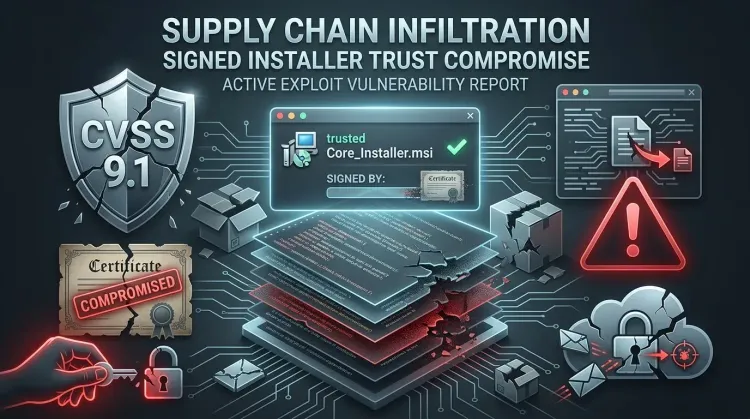
The most important part of the DAEMON Tools incident is not that malware was hidden in a popular Windows utility. It is that attackers appear to have tampered with digitally signed installers distributed from the vendor's official website, which means ordinary software download behavior became the intrusion path.
That makes this more than another malware story. It is a live reminder that software trust can fail at the distribution layer, where defenders often assume signed binaries and legitimate domains are enough to separate safe software from hostile code.
What happened
According to BleepingComputer's reporting on Kaspersky's findings, trojanized DAEMON Tools installers were being served from the official site beginning on April 8. The affected range reportedly included versions 12.5.0.2421 through 12.5.0.2434, with malicious code found in multiple signed components including DTHelper.exe, DiscSoftBusServiceLite.exe, and DTShellHlp.exe.
The campaign reportedly infected systems in more than 100 countries, but only a smaller subset received second-stage payloads. That matters because it suggests the first stage was doing more than simple mass infection. It was likely acting as a selective profiling layer, gathering system details so the operators could decide which victims deserved deeper follow-on access.
Why this attack matters
1. Trusted distribution became the attack surface
This was not described as a fake website, cracked installer, or typo-squatted package. The risk came from the normal delivery path itself. For defenders, that is the uncomfortable lesson. When a signed installer from a legitimate domain becomes hostile, common allow-listing assumptions get weaker fast.
2. The first stage enabled targeted follow-on compromise
Reporting says the initial payload gathered host details such as the hostname, MAC address, running processes, installed software, and locale. That kind of profiling supports selective escalation. Instead of burning advanced tooling on every infected system, attackers can reserve higher-value payloads for victims that match operational goals.
3. Supply-chain compromise compresses time to trust
Users, help desks, and some security controls are far less suspicious of software that arrives from an official vendor path. That trust gap gives attackers room to establish persistence before incident responders realize the problem started with a legitimate-looking installer.
What the malware appears to do
The first payload reportedly acts as an information stealer and system survey tool. From there, the operators can deliver a lightweight backdoor that executes commands, downloads files, and runs code directly in memory. In at least one reported case, Kaspersky observed a more capable QUIC RAT deployment.
That progression is important. It means the campaign was not only about broad infection numbers. It appears designed to separate commodity victims from strategically interesting ones, a pattern that fits threat intelligence concerns more than simple opportunistic adware-style abuse.
Why signed malware is operationally dangerous
Digital signing is useful, but it is not a guarantee of safety once a vendor distribution pipeline is compromised. If defenders over-trust signed software, they may delay containment because the binary looks legitimate at first glance.
That is why supply-chain incidents like this often need a different response mindset than ordinary phishing or drive-by malware. The question is not only whether the file is signed. It is whether the vendor's build, release, or distribution environment stayed trustworthy from source to download.
What defenders should do now
Hunt for exposure after April 8
Review whether DAEMON Tools was installed, updated, or executed in your environment on or after April 8. Pay special attention to the reported vulnerable version range and the named binaries.
Treat this as an incident response problem, not just a patch task
If the software was present, investigate host telemetry for persistence, suspicious outbound connections, in-memory execution, and follow-on payload retrieval. Simply uninstalling the tool may miss the real impact if a second stage already landed.
Reassess software trust controls
Use this case to test whether security tooling distinguishes between domain reputation and binary behavior. Legitimate download origin should not exempt a process from telemetry, sandboxing, or anomaly review.
Prioritize developer and admin endpoints
Even if DAEMON Tools is no longer broadly deployed, the systems that still use it may have elevated privileges, niche operational workflows, or access to sensitive data. That can make a relatively old utility a high-value lateral movement starting point once compromised.
Strategic takeaway
The DAEMON Tools case is a sharp example of why software supply-chain defense has to include the final delivery layer, not only source repositories and package managers. If an attacker can poison a vendor's signed installer channel, trust becomes the payload.
For defenders, the practical lesson is simple: treat vendor-hosted signed software as verifiable, not automatically trustworthy. That means stronger telemetry on installer execution, tighter review of unexpected software on privileged endpoints, and faster containment when a vendor distribution path is suspected of compromise.
References
FAQ
Written by
Lucas Oliveira
Research
A DevOps engineer and cybersecurity enthusiast with a passion for uncovering the latest in zero-day exploits, automation, and emerging tech. I write to share real-world insights from the trenches of IT and security, aiming to make complex topics more accessible and actionable. Whether I’m building tools, tracking threat actors, or experimenting with AI workflows, I’m always exploring new ways to stay one step ahead in today’s fast-moving digital landscape.
Hot TopicsLast 7 days
Categories
Stay Updated
Get the latest cybersecurity insights delivered to your inbox.