Phobos ransomware admin pleads guilty as Aether continues

Phobos ransomware: admin guilty plea & Aether pressure | 2026
Executive Summary
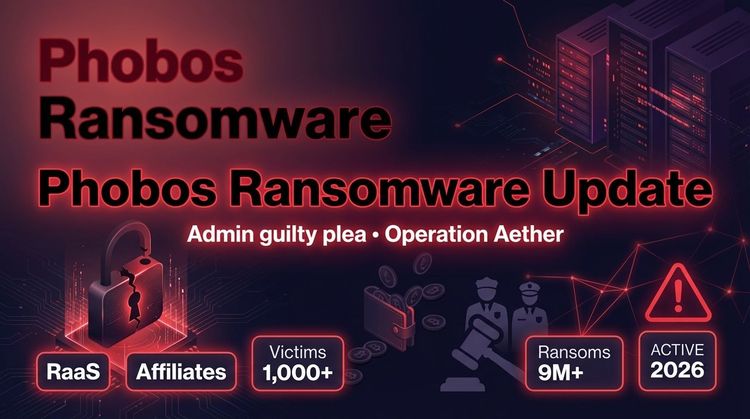
In March 2026, Phobos ransomware reporting confirmed that a key administrator, Evgenii Ptitsyn (43), pleaded guilty to wire fraud conspiracy in a case tied to a long-running ransomware-as-a-service (RaaS) operation. Multiple outlets cite 1,000+ victims and $39M+ in extortion payments attributed to the conspiracy.
For defenders, the key takeaway is not “Phobos is finished,” but that law-enforcement pressure creates churn: infrastructure moves, affiliate reshuffling, and reused initial-access playbooks. That turbulence is a practical window to tighten access controls and run targeted hunts.
What happened?
- Guilty plea: Reporting says Ptitsyn pleaded guilty to wire fraud conspiracy tied to administering the Phobos RaaS operation.
- Victim scale: Coverage cites 1,000+ impacted victims globally (with a large share in the United States).
- Monetization: The affiliate model described in reporting includes per-deployment decryption key fees (e.g., ~$300) plus revenue share.
- Ongoing disruption: Past law-enforcement actions under Operation Aether are referenced as continued pressure on Phobos-linked actors and infrastructure.
Confidence note: These points are based on public reporting and cited court records referenced by outlets below. Where exact figures differ between articles, we keep ranges and cite sources.
Who is affected?
Phobos has historically hit a broad set of targets, including:
- healthcare and hospitals
- education (schools)
- government and public services
- professional services and mid-market enterprises
Exposure commonly tracks initial access (stolen credentials, weak remote access posture) rather than a single product vulnerability.
Initial access & kill chain (MITRE-friendly)
Typical RaaS intrusion flow (high-level):
- Initial access via stolen credentials / exposed remote services
- Privilege escalation and credential access
- Discovery and lateral movement
- Data collection/exfiltration (varies by affiliate)
- Impact: encryption + extortion
Quick ATT&CK mapping (illustrative)
| Tactic | Technique | Why it fits RaaS cases |
|---|---|---|
| Initial Access | Valid Accounts | Credential theft / reuse is a common access path |
| Lateral Movement | Remote Services | Admin shares / remote execution in Windows estates |
| Impact | Data Encrypted for Impact | Ransomware encryption event |
Indicators and detection
What to look for (practical):
- anomalous privileged logons (new admin use, unusual geo/time)
- spikes in remote service creation / scheduled tasks
- unusual SMB admin share access and remote execution bursts
- backup deletion attempts and security tool tampering
Example hunt (generic pattern)
Hunt for the sequence: new privileged access -> rapid discovery/lateral movement -> encryption-like file operations.
Tune to your environment (EDR + Windows security logs + backup telemetry).
Containment & remediation checklist
🔴 Immediate containment (0–24h)
- Audit external access paths (VPN/RDP/VDI/admin portals) and close unnecessary exposure.
- Reset/rotate privileged credentials; enforce MFA everywhere possible.
- Review identity anomalies: impossible travel, MFA fatigue patterns, newly registered devices.
- Segment backup infrastructure and verify restore capability (offline/immutable where possible).
🟠 Hardening (24–72h)
- Reduce local admin sprawl; implement LAPS.
- Enforce conditional access for admin actions.
- Restrict lateral movement (SMB/RPC/WinRM) with segmentation and firewall rules.
🟡 Longer-term controls (1–4 weeks)
- Implement tiered admin model and PAM.
- Centralize logging and build ransomware playbooks (tabletop + restore drills).
Strategic analysis (what this signals)
RaaS ecosystems survive leadership arrests by reorganizing. But reorganization is noisy: new infrastructure, new affiliate comms, and reused tooling. Treat this as an opportunity to:
- tighten remote access,
- review credential theft exposure,
- and re-run ransomware hunts with fresh assumptions.
Frequently Asked Questions
What happened with Phobos in March 2026?
Reporting says a key Phobos administrator pleaded guilty to wire fraud conspiracy, and outlets cite 1,000+ victims and $39M+ in extortion payments.
Does this mean Phobos is gone?
No. These events can disrupt operations, but affiliates and playbooks often persist or rebrand.
What should we do first?
Inventory and secure remote access paths, rotate privileged credentials, and run targeted hunts for lateral movement and backup tampering.
Who is most at risk?
Organizations with exposed remote services, weak MFA, poor credential hygiene, and fragile backups.
References
- Phobos ransomware admin pleads guilty to wire fraud conspiracy: BleepingComputer, March 2026. https://www.bleepingcomputer.com/news/security/phobos-ransomware-admin-pleads-guilty-to-wire-fraud-conspiracy/
- Phobos ransomware leader facing 20 years in prison after pleading guilty: The Record, March 2026. https://therecord.media/phobos-ransomware-leader-facing-20-years
- Phobos ransomware leader pleads guilty, faces up to 20 years in prison: CyberScoop, March 2026. https://cyberscoop.com/phobos-ransomware-leader-guilty/
Written by
Lucas Oliveira
Research
A DevOps engineer and cybersecurity enthusiast with a passion for uncovering the latest in zero-day exploits, automation, and emerging tech. I write to share real-world insights from the trenches of IT and security, aiming to make complex topics more accessible and actionable. Whether I’m building tools, tracking threat actors, or experimenting with AI workflows, I’m always exploring new ways to stay one step ahead in today’s fast-moving digital landscape.
Hot TopicsLast 7 days
Categories
Stay Updated
Get the latest cybersecurity insights delivered to your inbox.