Crunchyroll confirms support data exposure after vendor incident

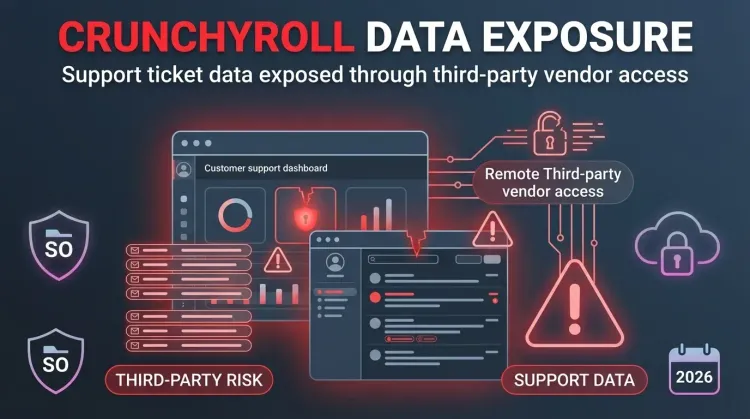
Crunchyroll confirms support data exposure after vendor incident | 2026
Executive Summary
Crunchyroll says customer support ticket data was exposed after a March 2026 incident involving a third-party vendor account, turning what first looked like another breach claim into a concrete reminder that outsourced support access remains a high-value attack path. Reporting from BleepingComputer and Recorded Future indicates the attacker claimed access on March 12, reached support tooling including Zendesk, collaboration systems, and identity-linked workflows, and downloaded roughly 8 million support tickets tied to 6.8 million unique email addresses.
The most important point for defenders is not the headline number. It is the access path. When business process outsourcing staff hold privileged access into ticketing, SSO-adjacent workflows, and internal collaboration tools, a single compromised workstation or credential can quickly become a data breach with large downstream impact.
What happened?
Based on currently available reporting and company statements, the sequence looks like this:
- March 12, 2026 — the threat actor claims to have gained access through an outsourced support worker tied to Crunchyroll's vendor operations.
- The actor told reporters the device was infected with malware and that the resulting access exposed credentials and sessions tied to multiple Crunchyroll tools.
- Screenshots shared with reporters allegedly showed access to Zendesk, Slack, Google Workspace, Wizer, MaestroQA, Mixpanel, and Jira-linked service tooling.
- The attacker claimed to have downloaded about 8 million support ticket records, including roughly 6.8 million unique email addresses.
- Crunchyroll later said the leaked data appears legitimate and that the information is primarily limited to customer service ticket data after an incident involving a third-party vendor.
- The company also said it had not identified evidence of ongoing access at the time of its public response.
Some details remain unconfirmed, including the exact intrusion method on the vendor-side device, the full scope of internal application access, and whether the actor extracted more than support-ticket data. But the company statement is enough to move this from rumor to a real supply-of-access problem.
Who is affected?
The exposed population appears to be users who interacted with Crunchyroll support channels, not necessarily the entire subscriber base.
According to the reporting reviewed for this post, the leaked ticket data may include:
- names
- usernames or login references
- email addresses
- IP addresses
- rough geographic information
- ticket contents
- in limited cases, payment-related details users voluntarily typed into tickets
That matters because support records often contain more sensitive operational context than a standard customer table. Ticket threads can reveal failed payment flows, identity verification exchanges, account-recovery discussions, screenshots, and troubleshooting details that attackers can later recycle in social engineering or account takeover attempts.
Initial access & kill chain
This incident is best understood as a third-party help-desk intrusion pattern rather than a conventional direct breach of a consumer platform.
Likely kill chain
- Vendor-side compromise — the attacker reportedly compromised or infected a support worker device associated with a third-party provider.
- Credential/session abuse — that access appears to have exposed valid credentials, session access, or authenticated workflow access into Crunchyroll-linked systems.
- Tool pivoting — the attacker then moved into support and collaboration platforms, including systems that are often lightly segmented because they are treated as business apps rather than security-critical assets.
- Data collection — support-ticket records were allegedly bulk downloaded from Zendesk.
- Extortion pressure — the actor reportedly demanded payment in exchange for suppressing publication of the data.
MITRE ATT&CK-aligned view
| Tactic | Technique | ID | Relevance |
|---|---|---|---|
| Initial Access | Valid Accounts | T1078 | Vendor-linked access appears central to the intrusion path |
| Credential Access | Input Capture / Malware-assisted theft | T1056 | Reported compromise of a support worker endpoint suggests credential or session theft |
| Discovery | Account Discovery | T1087 | Broad application access would require identifying reachable tools and roles |
| Collection | Data from Information Repositories | T1213 | Support-ticket systems are structured data sources with user context |
| Exfiltration | Exfiltration to Cloud or Web Service | T1567 | Bulk export of support-ticket records fits web-based data removal patterns |
| Impact | Data Manipulation / Extortion enablement | T1565 | Stolen records were allegedly leveraged for extortion pressure |
Why BPO and support access matter so much
The deeper lesson here is structural. Many enterprises correctly protect production systems while giving external support teams broad day-to-day access to customer tooling, internal queues, collaboration systems, and identity and access management pathways.
That creates a dangerous asymmetry:
- outsourced users often hold real business access
- their devices may sit outside the enterprise's strongest control plane
- support tools concentrate user data in one place
- ticket content frequently contains free-text secrets and recovery context
The result is that a compromise that starts outside the corporate perimeter can still produce enterprise-grade impact. For defenders, that means BPO and help-desk exposure should be modeled as privileged access, not as a low-risk business convenience.
Indicators and detection priorities
Public reporting does not include a full IOC set, so defenders should focus on telemetry patterns consistent with unauthorized support-tool access.
Priority log sources
- SSO / identity logs — unusual vendor account sign-ins, new device fingerprints, MFA anomalies, impossible travel, or abnormal session refreshes
- Endpoint telemetry — malware or stealer behavior on vendor-managed endpoints, especially browsers used for administrative or support access
- Zendesk / ticketing logs — bulk export actions, unusual search patterns, access to historical tickets, API token misuse, or mass attachment retrieval
- Slack / collaboration logs — abnormal channel discovery, private-channel access expansion, or session reuse from unfamiliar IP ranges
- Google Workspace / SaaS audit trails — app-to-app pivoting after a support account sign-in
Example SPL pattern
index=saas_audit sourcetype IN (okta, zendesk, slack, gsuite)
| search user_role=*vendor* OR actor_email="*@vendor*"
| stats count values(action) values(src_ip) values(user_agent) earliest(_time) latest(_time) by actor_email
| where count > 25
This is only an example pattern, but the general idea is to identify outsourced accounts whose application activity volume or access breadth suddenly changed.
Containment & remediation checklist
🔴 Immediate containment (0–24h)
- suspend or step-up verify all vendor-linked support accounts with broad ticket access
- revoke active sessions across Zendesk, Slack, Google Workspace, and related SaaS platforms
- rotate SSO credentials, API tokens, and service-linked secrets tied to support workflows
- review whether browser session theft could have bypassed normal MFA protections
- identify and preserve audit logs before retention windows or vendor-side cleanup removes evidence
- restrict bulk export capability in ticketing systems while the investigation is active
- notify fraud, support, and trust-and-safety teams that exposed tickets may now be reused in phishing or impersonation attempts
🟠 Hardening (24–72h)
- enforce device posture checks for vendor accounts before SaaS access is granted
- isolate vendor roles from internal collaboration spaces that are not operationally necessary
- segment ticket access so agents cannot freely browse large volumes of historical cases
- remove embedded secrets, screenshots, and sensitive payment fields from standard support workflows where possible
- implement anomaly detection for large-scale ticket export, search bursts, and unusual admin actions
- validate that least-privilege policies exist for support QA, coaching, analytics, and ticket review tools
🟡 Longer-term controls (1–4 weeks)
- reclassify outsourced support access as privileged third-party access in the risk model
- require stronger vendor endpoint controls or managed browser isolation for high-risk support roles
- redesign support processes to avoid collecting sensitive data in free-text ticket bodies
- build abuse cases for BPO compromise into tabletop and incident response exercises
- add contractual logging, retention, and containment requirements for customer-data handling vendors
- continuously test whether SSO, help-desk, and collaboration apps can be chained from one compromised support identity
Strategic analysis
This incident fits a pattern that defenders should already recognize from recent attacks against retailers, SaaS support environments, and outsourced help desks. Attackers do not need deep production access if they can land on a trusted human sitting between the company and its customers.
Support environments are especially attractive because they combine three things in one place:
- broad visibility into user problems and identities
- enough tooling access to pivot across business systems
- free-text data that users often overshare during account or billing disputes
That combination turns support platforms into a bridge between human trust and technical access. For security leaders, the lesson is straightforward: if a third party can see customer tickets, that third party is inside the blast radius.
References
- Crunchyroll probes breach after hacker claims to steal 6.8M users' data
- Anime streaming giant Crunchyroll says hacker stole data related to customer service tickets
- Crunchyroll probes breach after hacker steal users data, BleepingComputer reports
- Discord disclosed third-party support system breach affecting 5.5 million users
Bottom line
Crunchyroll's confirmed support-data exposure is a third-party access warning, not just a consumer-breach headline. If outsourced support staff can reach customer tooling, their identities, devices, and session controls have to be defended like privileged access.
FAQ
Written by
Lucas Oliveira
Research
A DevOps engineer and cybersecurity enthusiast with a passion for uncovering the latest in zero-day exploits, automation, and emerging tech. I write to share real-world insights from the trenches of IT and security, aiming to make complex topics more accessible and actionable. Whether I’m building tools, tracking threat actors, or experimenting with AI workflows, I’m always exploring new ways to stay one step ahead in today’s fast-moving digital landscape.
Hot TopicsLast 7 days
Categories
Stay Updated
Get the latest cybersecurity insights delivered to your inbox.